What Makes a Los Angeles Commercial Shoot Different
Why Los Angeles dominates commercial production: crew depth, location density, permitting, gear access, post, and what it means for your budget in 2026.

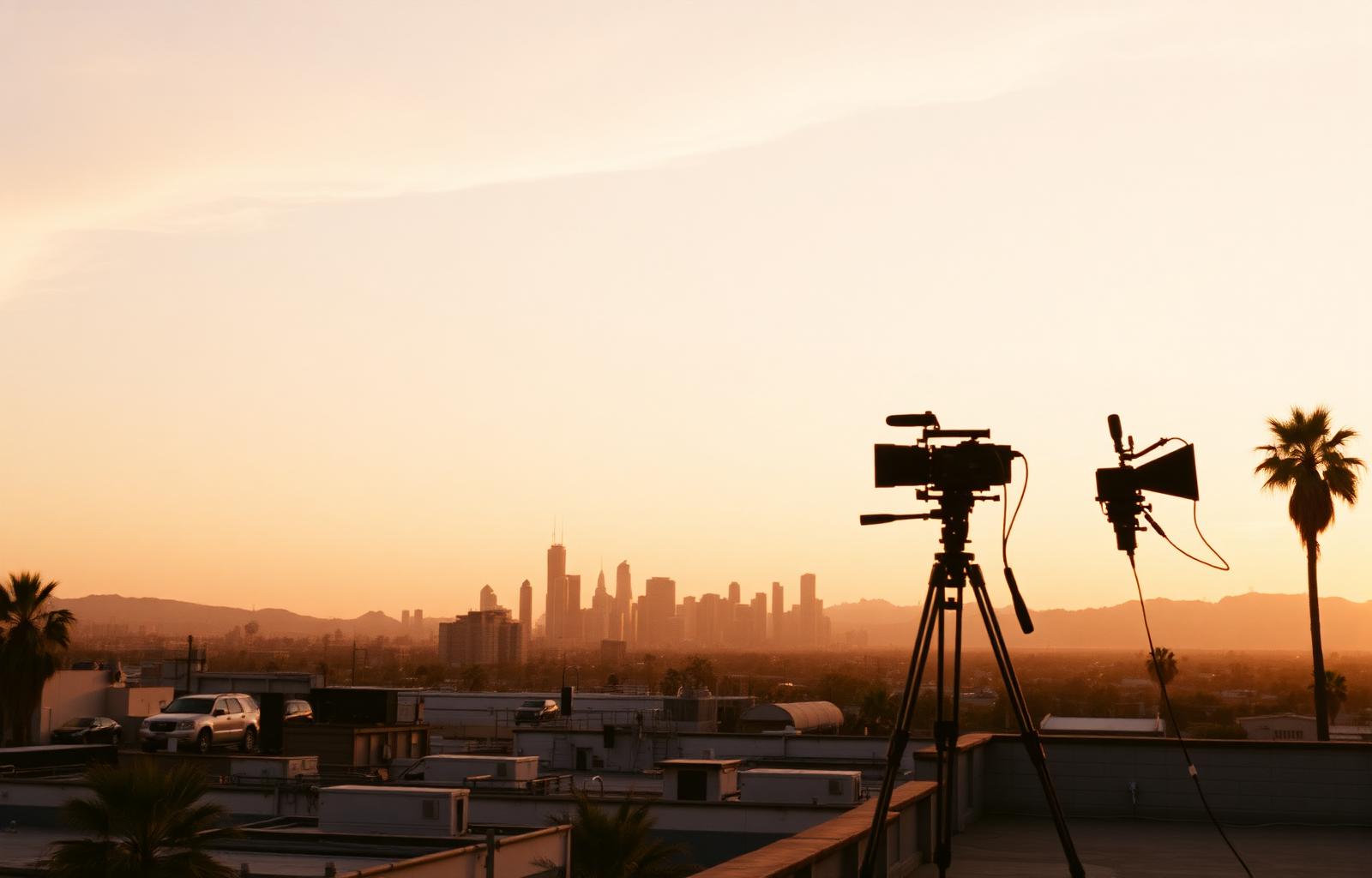
Los Angeles isn't just another production city. It's the densest concentration of crew, gear, locations, and post-production talent on the planet — and that changes everything about how a commercial shoot comes together. If you're a brand evaluating where to produce your next spot, understanding what makes a Los Angeles commercial shoot structurally different will help you budget realistically, scope the right partner, and get a finished film that actually moves the needle.
This guide breaks down the practical differences — crew depth, location access, permitting, gear, post, weather, and cost — so you can make an informed call before you sign a bid.
Why Los Angeles Is the Default for Commercial Production
Roughly 40% of all U.S. commercial production spend flows through Los Angeles. That isn't marketing copy — it's a structural reality created by a century of film and television infrastructure compounding in one metro area. The result is a production ecosystem where any role you need, any piece of gear, any location type, and any post-production specialty exists within a 30-mile radius.
For brands, that density translates into three concrete advantages:
- Speed. A spot that takes three weeks to staff in a secondary market often takes three days in LA.
- Quality ceiling. The top 1% of DPs, gaffers, editors, and colorists work here. You can hire them on a one-day commercial.
- Optionality. If your first-choice director, location, or piece of gear falls through, the bench is deep enough to recover the same day.
That depth is the single biggest reason national brands keep returning to LA even when tax incentives are stronger elsewhere.
Crew Depth: The Real Difference
A typical mid-budget commercial shoot day in LA involves 25–40 crew members across departments — camera, lighting, grip, art, wardrobe, hair and makeup, sound, production, and client services. In most other U.S. cities, you can staff that crew, but you're often picking from a shallow pool where the best people are already booked.
In Los Angeles, the depth means:
- Specialists exist for everything. Need a phantom tech for a 1,000fps product shot? A car rigging team? A food stylist who's worked on 200 spots? They're a phone call away.
- Department heads come with full crews. A working DP in LA brings a tested gaffer, key grip, and 1st AC they trust. That reduces the "first day together" friction that shows up on screen.
- Union and non-union flexibility. IATSE crews work alongside non-union freelancers, and good producers know how to staff appropriately for the budget tier.
The practical impact: an LA crew typically shoots 15–25% more usable footage per day than an equivalently sized crew in a thinner market, simply because the muscle memory is deeper.
Locations: The Whole World Within 90 Minutes
Los Angeles County contains more shootable location archetypes than any other region on earth. Within a 90-minute drive of downtown you can shoot:
- Desert (Mojave, Antelope Valley)
- Mountains and pine forest (Angeles National Forest, Big Bear)
- Pacific coastline (Malibu, Palos Verdes, El Matador)
- Urban downtown (DTLA, Long Beach)
- Mid-century residential (Pasadena, Hancock Park, Palm Springs)
- Industrial (Vernon, City of Industry, San Pedro Port)
- Suburban Americana (the entire San Fernando Valley)
- Stage work (hundreds of soundstages across Culver City, Hollywood, Burbank)
For a commercial that needs three distinct looks in two days, this matters enormously. You can shoot a "beach lifestyle" scene at 7am in Malibu, a "rooftop urban" scene at noon in DTLA, and a "suburban dinner" scene at 5pm in Studio City — all on the same shoot day, with the same crew, without a single travel day or per-diem hotel night.
What this saves you: A three-look spot produced in LA typically costs 30–50% less than the same spot produced as a multi-city shoot, primarily because you eliminate travel days, second crew hires, and equipment re-rentals.
Permitting and FilmLA
Los Angeles has the most mature film permitting system in the country, administered primarily by FilmLA for the City and County of Los Angeles. Most other jurisdictions in the region (Beverly Hills, Santa Monica, Long Beach, Pasadena) run their own permit offices with similar processes.
What this looks like in practice:
- Standard permits for street, sidewalk, or public-property filming typically take 3–5 business days to process.
- Rush permits are available for an additional fee, often within 24–48 hours.
- Insurance requirements are well-defined: a $1M general liability certificate naming the city as additional insured is the standard baseline. For stunts, vehicles, or pyrotechnics, the requirements scale up.
- Neighborhood notifications are required for any residential filming, typically requiring signed consent from a percentage of adjacent residents.
A good LA production company has dedicated permit coordinators who handle this end-to-end. If you're being bid by a producer who treats permitting as an afterthought, that's a warning sign — permit failures are one of the most common reasons commercial shoots get delayed or cancelled day-of.
For a deeper breakdown of the permitting and insurance side, see our guide on filming in Los Angeles.
Gear Access: Same-Day Anything
LA has the deepest equipment rental ecosystem in the world. Keslow, Panavision, Otto Nemenz, Hand Held Films, Sim, Quixote, MBS — all the major houses have their flagship locations here, with overflow inventory other markets can only dream about.
What that means on a production:
- If your DP wants to switch from an ARRI Alexa Mini LF to a Sony Venice 2 the night before, you can do it.
- Specialty packages — anamorphic lens sets, RED V-Raptor, technocranes, Steadicams, MoVI Pro stabilizers, drone packages with cleared operators — are available with a same-day call.
- Lighting packages scale infinitely. Need a 100kW HMI for a night exterior? It's in stock. Need 40 Astera tubes for a music-video-style commercial? Same.
For brands, the gear depth shows up in two places: the shot list you're able to execute, and the contingency you have when something breaks. A camera body that goes down mid-day in Kansas City might end the shoot. In LA, a runner has a replacement on set in 90 minutes.
Post-Production Density
The same depth applies to post. LA is home to the top tier of:
- Editorial houses (Cosmo Street, Arcade, Whitehouse, Final Cut)
- Color grading suites (Company 3, The Mill, MPC, Apache)
- VFX and finishing (Method, a52, Ntropic)
- Sound design and mix (Lime Studios, Margarita Mix, Therapy Studios)
Most national commercial work cuts and finishes in LA even when it shot elsewhere, because the post talent simply lives here. If you produce your commercial in Los Angeles, you can do dailies-to-delivery in one city, with in-person creative reviews — which consistently produces a better final film than remote-only post workflows.
Weather and Daylight
LA averages 284 sunny days per year with extremely predictable weather between April and November. For commercial production, that translates into:
- Reliable schedules. Weather day insurance is rarely triggered; you can confidently commit to a single shoot date.
- Long usable daylight windows. From May through September, you have 12–14 hours of shootable daylight, which lets you bank coverage on tight schedules.
- Magic hour is consistent. The famous LA golden hour is genuinely reliable, which matters for any commercial leaning on natural-light aesthetics.
This is a real cost advantage. A spot that needs to capture sunny exteriors will often shoot 30% more efficiently in LA than in markets with unpredictable weather windows.
What This Means for Cost
LA commercial shoots are not the cheapest in absolute dollars — Atlanta, New Mexico, and several international markets have aggressive tax incentives that lower the headline number. But on a cost-per-finished-second-of-usable-footage basis, LA is consistently competitive because:
- You shoot more usable coverage per day with a tighter, more experienced crew.
- You eliminate travel days for multi-look spots.
- You avoid the contingency costs that come with thinner crew/gear markets.
- You can finish in the same city you shot in.
For most national brand work in the $50,000–$500,000 budget range, LA produces the best finished film per dollar spent. For ultra-high-volume content programs or shoots that genuinely need an exotic non-LA location, other markets can win on price.
For a deeper breakdown of what commercial production actually costs in LA across budget tiers, see our Los Angeles commercial production cost guide.
The Right Production Partner
The structural advantages of Los Angeles only translate into a better commercial when your production company knows how to use them. The things to look for:
- Local relationships. A producer with five-year relationships at rental houses, locations, and crew agencies gets better rates and better people than one calling cold.
- In-house creative. The best LA shops blend directing talent with production capability, so the creative and the execution are aligned from the bid.
- Transparent bidding. A real LA bid is itemized — talent, crew, gear, locations, permits, insurance, post — not a single line item. If your bid is opaque, you're losing leverage.
- Reel that matches your tier. A company that consistently delivers $200K spots is the right partner for a $200K spot. Stretching either direction usually disappoints.
Learn more about our commercial production services or view our work to see how we approach LA shoots across budget tiers.
Common Mistakes Brands Make Producing in LA
- Hiring out-of-market and "flying in" crew. Pays travel and per-diem on people you could hire better locally.
- Underestimating permit lead time. Booking talent before permits are confirmed creates expensive cancellations.
- Treating LA like a remote shoot. The biggest value of producing in LA is having the client and agency on set; remote-only oversight wastes the local advantage.
- Picking a vendor on price alone. A bid that's 20% cheaper than the market usually reflects a thinner crew, less experienced HODs, or hidden costs that surface in post.
Ready to Produce in Los Angeles?
If you're scoping a commercial shoot — whether it's a single-location product spot or a multi-day national campaign — the right Los Angeles production partner will save you money and produce a better finished film than any other approach.
Get in touch for a transparent, itemized bid and a creative response to your brief.
Tell us what you're making
Posted is a West Hollywood production company building commercials, music videos, branded content, and product films. Send a brief and you'll get an approach, a budget band, and a schedule back within one business day.
Send a brief →